IT Infrastructure Management: Keeping Your Business Technology Reliable

IT Infrastructure Management: Keeping Your Business Technology Reliable
 Naka Team
IT infrastructure management is the continuous work of keeping the systems your business runs on — networks, servers, storage, data centers, endpoints, and the connections between them — available, secure, current, and performing. It covers monitoring and maintenance, but also the planning that decides what gets replaced, what gets consolidated, and what gets retired before it fails.
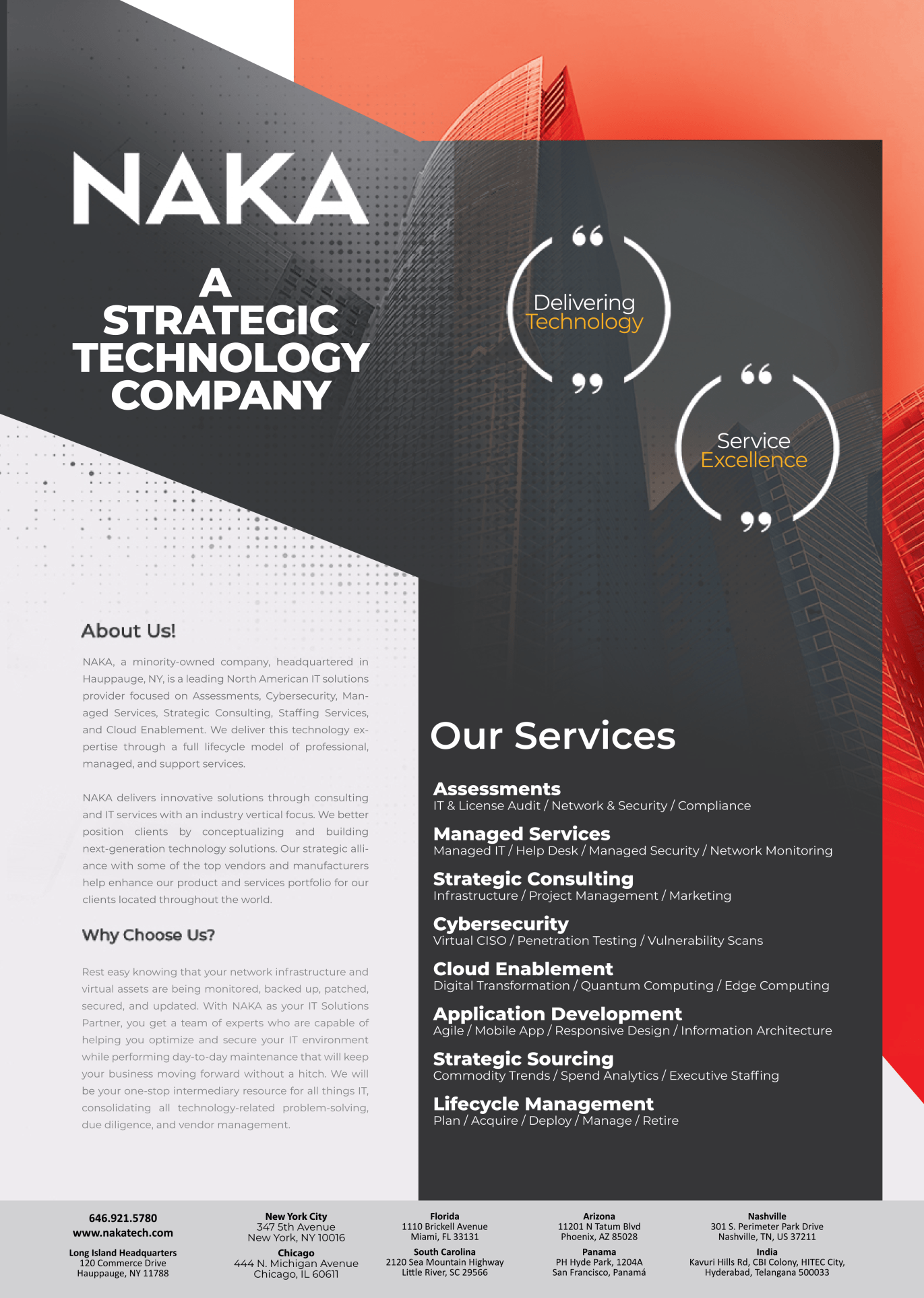
NAKA manages infrastructure for commercial, federal, and educational organizations that can’t afford it to be unreliable. We take operational ownership of the environment—from the cabling in the wall to the servers and cloud workloads—and run it to defined service levels, so your team can focus on the work that differentiates the business.
Infrastructure Management Is Not the Same as IT Support
The distinction matters, because it’s the difference between two very different cost structures.
IT support answers the question “what’s broken and who can fix it.” Infrastructure management answers a harder one: what’s degrading, what’s approaching capacity, what’s out of support next year, and what single component would take the business offline if it failed tonight. One is reactive by design. The other exists to make the first one rare.
Most environments drift toward fragility quietly. A switch runs past its supported life. A server fills up. A firmware version falls three revisions behind. Backups run but nobody tests a restore. None of these generate a help desk ticket, and all of them eventually generate an outage. Infrastructure management is the discipline of finding them first.
What Our IT Infrastructure Management Services Cover
Scope is agreed during assessment. A typical engagement includes:
- Remote monitoring and management — continuous visibility into servers, network devices, storage, and endpoints, with alerting on thresholds rather than on failures
- Server administration — provisioning, configuration, patching, performance tuning, and capacity management across physical, virtual, and cloud-hosted servers
- Network management — LAN and WAN operations, SD-WAN, wireless, and connectivity, with performance monitoring and configuration control
- Data center services — management and optimization of data center infrastructure, whether owned, colocated, or in transition
- Backup and disaster recovery — protection design, recovery objectives set against business impact, and tested restores rather than assumed ones
- Network security — firewall management, intrusion detection and prevention, segmentation, and layered policy enforcement
- Endpoint and mobile device management — configuration, patching, compliance enforcement, and security across laptops, desktops, and mobile devices
- Lifecycle management — asset inventory, warranty and support tracking, refresh planning, procurement, and retirement
- Service desk — a single point of contact for users, incident management, and employee onboarding and offboarding
- IT roadmap and SLA governance — documented service levels, regular reporting against them, and a forward plan tied to business priorities rather than to hardware age alone
Network and Physical Infrastructure
Infrastructure management stops being credible if it starts above the physical layer. Ours doesn’t.
LAN and WAN services. High-availability connectivity designed, deployed, and supported around the clock, with performance monitored rather than assumed.
SD-WAN. Software-defined connectivity that improves application performance across sites while reducing the operational complexity of traditional WAN architectures.
Wireless. Design, deployment, and management of wireless networks built for coverage and density — the two things that usually go wrong in environments that grew organically.
Structured cabling. The foundation everything else depends on, and the layer most providers won’t touch. We design and install it, which means infrastructure problems don’t stall at the boundary between “network” and “facilities.”
Data center. Management and optimization of data center environments, including consolidation and migration work where the right answer is fewer facilities rather than better ones.
We work with enterprise platforms from partners including Cisco, Microsoft, Dell EMC, and HP Enterprise, and we support the estate you already have rather than requiring you to standardize on ours.
How We Engage
- Assessment. We inventory the environment — hardware, software, licensing, network topology, support status, and dependencies — and document what we find. For many organizations this is the first complete picture they’ve had.
- Risk and roadmap. We identify single points of failure, end-of-support exposure, capacity constraints, and security gaps, then sequence remediation against business impact and budget.
- Stabilization. Urgent items get addressed and the environment is brought to a documented, supportable baseline before steady-state management begins.
- Steady-state management. Monitoring, patching, administration, backup verification, and service desk move to our team under agreed service levels.
- Review and planning. Regular reporting on availability, incidents, and capacity, with a periodic strategy conversation about what the next twelve months require.
Reliability Is Designed, Not Hoped For
Uptime is a product of architecture and maintenance discipline, not of responsiveness. An environment with a single core switch, an untested backup, and a server three years past its support date will fail eventually, no matter how quickly someone answers the phone when it does.
So the work that produces reliability is unglamorous and continuous: redundancy where failure would be material, patching on a schedule rather than on an incident, restores tested rather than trusted, capacity tracked before it becomes urgent, and documentation kept current so recovery doesn’t depend on one person’s memory. Our certified engineers run that cycle as routine, and the reporting shows you it happened.
Built for Regulated and Complex Environments
NAKA has spent over 20 years working in environments where infrastructure failure carries consequences beyond inconvenience — commercial organizations with uptime obligations, federal work with its own standards, and educational institutions balancing open access against security.
That experience shows up in how we handle compliance: configuration baselines that hold, access controls that are documented as well as implemented, audit evidence collected as a by-product of normal operations rather than assembled under deadline, and continuous data governance. Our infrastructure practice is built alongside a dedicated cybersecurity practice, recognized among the top cybersecurity services providers in 2023.
Industries We Serve
Infrastructure requirements vary more by industry than by company size. A manufacturer with equipment on the plant network, a hospital system with clinical uptime obligations, a bank under examination, and a school district with seasonal load patterns each need something different from the same underlying disciplines. NAKA delivers IT infrastructure management across banking and financial services, healthcare, manufacturing, retail, education, hospitality, media and entertainment, automotive, energy, the public sector, and nonprofits.
Why NAKA
- Over 20 years managing IT infrastructure for commercial, federal, and educational organizations
- 245 skilled IT specialists across 9 global locations, supporting genuine around-the-clock coverage
- 491 clients and 862 completed projects across eleven vertical markets
- Certified engineers with enterprise infrastructure expertise, including hybrid and cloud-native environments
- End-to-end capability — structured cabling, network, data center, servers, endpoints, security, and cloud handled by one accountable partner
- 24/7 monitoring with rapid remediation and service levels defined in writing
- Recognized among top cybersecurity services providers (2023) and a Long Island Top Workplace (2024–2026)
Frequently Asked Questions
What’s included in IT infrastructure management? At minimum: monitoring, patching, server and network administration, backup management, and security. Stronger engagements add lifecycle planning, documentation, capacity management, and a roadmap — the parts that reduce how often anything needs fixing.
Do you replace our internal IT team? Usually not. Co-managed arrangements are common, with our team taking monitoring, infrastructure administration, and after-hours coverage while yours keeps applications, business systems, and internal projects.
Can you manage infrastructure you didn’t build? Yes, and most engagements start that way. We assess first, document what exists, stabilize what needs stabilizing, and then move to steady-state management.
Do you handle hardware procurement and refresh? Yes. Lifecycle management covers asset inventory, warranty and end-of-support tracking, refresh planning, procurement, and retirement, so replacement is budgeted rather than triggered by a failure.
What about hybrid environments? Most of what we manage is hybrid. On-premises servers, data center infrastructure, and cloud workloads are managed as one environment, because that’s how they fail — at the boundaries between them.
How quickly can you take over? Monitoring and support typically go live within weeks. Full transition — documentation, remediation, standardization, and a roadmap — generally runs 60 to 90 days depending on the size and condition of the environment.
Request an Infrastructure Assessment
Most engagements start with an assessment: what you’re running, what condition it’s in, where the single points of failure are, and what the next twelve months require. You get a documented picture of your environment and a prioritized roadmap — useful whether or not you engage us to deliver it.
NAKA has spent 20 years managing IT infrastructure for commercial, federal, and educational organizations. Request an infrastructure assessment