How IT Strategy Consulting Helps Businesses Make Smarter Technology Decisions
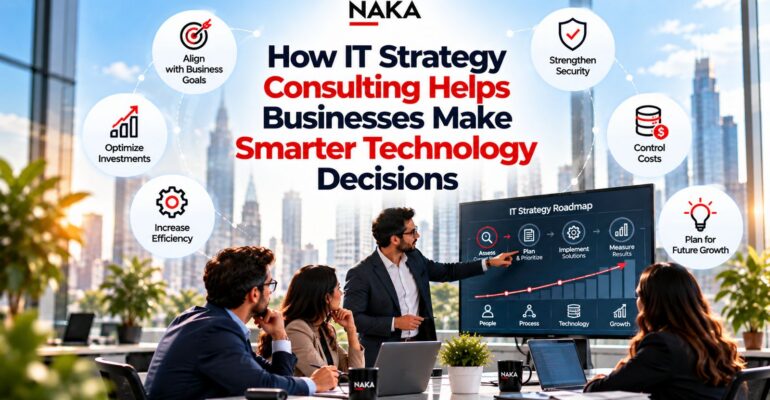
How IT Strategy Consulting Helps Businesses Make Smarter Technology Decisions
 Naka Team
Why technology decisions need a strategy
Most businesses don’t have a technology problem. They have a technology decision problem.
A new cloud platform gets signed because a vendor offered a good discount. A security tool is bought after a scare at a competitor. A server refresh is pushed back another year because the budget went to something more urgent. Each choice makes sense on its own. Together, they create an environment that is expensive to run, hard to secure, and slow to change.
That is the gap IT strategy consulting fills. Instead of reacting to each need as it appears, a strategic IT consultant helps you decide what to invest in, when, and why — based on where your business is going, not just what broke last week.
In this guide, we explain what IT strategy consulting is, the signs you need it, and the specific ways it leads to smarter, more confident technology decisions.
What is IT strategy consulting?
IT strategy consulting is an advisory service that aligns your technology investments with your business goals. A consultant assesses your current environment, clarifies where the business is heading, and builds a prioritized roadmap to close the gap between the two.
It is different from day-to-day IT support. Support keeps today’s systems running. Strategy decides which systems you should be running two, three and five years from now — and how to get there without wasting budget or adding risk.
A typical IT strategy engagement covers:
- Technology assessment — an honest inventory of infrastructure, applications, security posture, contracts and skills.
- Business alignment — translating growth plans, compliance needs and customer expectations into technology requirements.
- Roadmap and prioritization — sequencing initiatives by impact, cost, risk and dependency.
- Budget and cost planning — forecasting spend, total cost of ownership (TCO) and return on investment.
- Risk and security planning — making cybersecurity and resilience part of every decision, not an afterthought.
- Vendor and platform guidance — choosing the right partners and solutions for your needs, not the vendor’s.
The output is not a slide deck that sits in a drawer. It is a living plan your leadership team can use to make decisions quickly and defend them with data.
Signs your business needs IT strategy consulting
You don’t need to be a large enterprise to benefit from a technology strategy. If several of these sound familiar, it’s time:
- IT spend keeps rising, but results don’t. Budgets grow every year, yet leadership can’t point to clear business outcomes.
- Decisions are driven by vendors or emergencies. Purchases happen after a sales pitch or an outage rather than a plan.
- You’re paying for things you don’t use. Overlapping tools, unused licenses and auto-renewed contracts quietly drain budget.
- Security is reactive. Controls are added after incidents, audits or insurance questionnaires instead of by design.
- Growth is outpacing your systems. New locations, acquisitions, remote teams or customer demands strain infrastructure that wasn’t built for them.
- Cloud adoption happened piecemeal. Workloads are scattered across platforms with no clear cost, governance or integration model.
- Aging hardware is a looming risk. End-of-life servers, switches and endpoints need replacing, but there’s no refresh plan.
- Leadership and IT speak different languages. The board wants outcomes; the IT team talks in tickets and specs.
Each of these is a symptom of the same root cause: technology choices being made without a shared strategy.
7 ways IT strategy consulting helps you make smarter technology decisions
1. It ties every investment to a business outcome
A good IT strategy starts with the business, not the technology. Consultants work with leadership to define what success looks like — faster order processing, better patient experience, lower operating costs, entry into a new market — and then map technology to those goals.
The result is a simple test for every proposal: Does this move us toward a defined outcome? If not, it waits.
2. It replaces guesswork with a clear picture of where you are
You can’t plan a route without knowing your starting point. A structured assessment uncovers the real state of your environment: which systems are critical, which are end-of-life, where data lives, how secure it is, and what you are actually paying for.
That baseline often surfaces quick wins on its own — redundant tools, idle cloud resources, or contracts that can be renegotiated.
3. It prioritizes what matters most
Every business has more technology ideas than budget. IT strategy consulting ranks initiatives by business impact, cost, risk and dependency, so you tackle the right things in the right order.
For example, migrating applications to the cloud before modernizing the network that connects them can create performance problems. A roadmap sequences that work correctly from the start.
4. It controls costs and improves ROI
Strategic planning shifts the focus from purchase price to total cost of ownership. That includes licensing, support, energy, staffing, downtime and eventual replacement.
Consultants also help you right-size spend through lifecycle management, contract consolidation and smarter procurement. In one NAKA engagement, a Fortune 500 luxury brand that was struggling to keep its warranty, license, subscription and maintenance contracts under control gained visibility and savings across its portfolio (read the case study).
5. It builds security and compliance into every decision
When security is bolted on later, it costs more and protects less. A strategic approach evaluates every initiative for its risk, data protection and regulatory impact — whether that’s HIPAA in healthcare, PCI DSS in retail or financial regulations in banking.
For organizations without a full-time security leader, a CISO as a Service model can provide executive-level security direction as part of the overall strategy.
6. It brings vendor-neutral clarity to complex choices
Cloud vs. on-premises. Hybrid vs. multi-cloud. Build vs. buy. SD-WAN vs. traditional WAN. These decisions are hard, and vendors naturally favor their own products.
An experienced IT strategy partner compares options against your requirements, budget and existing environment. The goal is the right fit, not the biggest sale.
7. It prepares your business to scale and adapt
Technology should make growth easier, not harder. A strong IT strategy plans for future capacity, new locations, remote and hybrid work, and emerging capabilities like automation, analytics and AI — so you can move quickly when opportunities appear.
It also gives you a framework to evaluate new technologies as they arrive, so you adopt what helps and skip what doesn’t.
What an IT strategy consulting engagement looks like
Every organization is different, but most engagements follow five stages:
- Discovery — Interviews with leadership, IT and key departments to understand goals, pain points, compliance obligations and constraints.
- Assessment — A review of infrastructure, applications, cloud usage, security controls, contracts, and support processes to establish a clear baseline.
- Gap analysis — A comparison of where you are with where you need to be, identifying risks, inefficiencies and opportunities.
- Roadmap — A prioritized, phased plan with timelines, budget estimates, owners and measurable outcomes for each initiative.
- Execution and review — Support implementing the plan, plus regular reviews to measure progress and adjust as the business changes.
The final stage matters most. Strategy is not a one-time project; the best roadmaps are revisited at least annually so they stay aligned with the business.
How to choose the right IT strategy consulting partner
The value of a strategy depends on the people behind it. When evaluating consultants, look for:
- Business-first thinking. They ask about revenue, customers and operations before they ask about servers.
- Breadth across the stack. Cloud, data center, networking, cybersecurity, applications and end-user computing all affect each other. Your partner should understand all of them.
- Industry experience. Healthcare, finance, education, manufacturing and the public sector each have unique regulations and priorities.
- Vendor relationships without vendor bias. Strong partner networks give you access and pricing; independence keeps recommendations honest.
- The ability to execute. A roadmap is only useful if it gets implemented. Partners who can also deliver managed services, cloud migrations and security operations close the gap between plan and results.
- Proven outcomes. Ask for case studies and references from organizations like yours.
How NAKA helps businesses build a smarter IT strategy
NAKA is a strategic technology company headquartered in Central Islip, New York, with locations across North America and internationally. Strategic consulting sits alongside our assessments, cybersecurity, managed services, staffing and cloud enablement, delivered through a full lifecycle model of professional, managed and support services.
That breadth is what makes our strategy work practical. When we recommend a path, we can also help you walk it:
- Cloud + Data Center Transformation — data center modernization, hybrid cloud design and infrastructure as a service.
- Cybersecurity — network, endpoint, cloud and data security, plus advisory and managed security services.
- Digital Operations — managed network, cloud, data center and unified communications.
- Data Intelligence & Automation — analytics, machine learning and robotic process automation.
- Lifecycle Management — hardware and software procurement, refresh planning and contract optimization.
We serve organizations across industries including healthcare, financial services, education, manufacturing, retail and the public sector. Through the NAKA Partner Network, we work with leading technology providers such as Cisco, Dell, HPE, Microsoft and Nutanix — while keeping our recommendations focused on what’s right for you.
Our clients notice the difference. One healthcare IS manager put it simply: NAKA consistently looks for the best technical solution for the organization, not the most expensive option or the one with the best margin.
Ready to make smarter technology decisions?
Whether you’re planning a cloud migration, tightening security, consolidating vendors or building a multi-year IT roadmap, NAKA’s consultants can help you prioritize with confidence.
Book a discovery call with our IT experts or call our sales team at 833.GET.NAKA.
Frequently asked questions about IT strategy consulting
What does an IT strategy consultant do?
An IT strategy consultant assesses your current technology, clarifies your business goals, and builds a prioritized roadmap that aligns the two. They advise on investments, budgets, security, vendors and timing so leadership can make confident technology decisions.
How is IT strategy consulting different from managed IT services?
IT strategy consulting decides what technology you should invest in and why. Managed IT services handle the ongoing operation, monitoring and support of that technology. Many businesses use both: strategy sets the direction, and managed services keep everything running.
Is IT strategy consulting only for large enterprises?
No. Small and mid-sized businesses often benefit the most, because every technology dollar has to work harder. A clear strategy helps growing organizations avoid costly missteps and scale without rebuilding their environment later.
How long does it take to build an IT strategy?
It depends on the size and complexity of your organization. Smaller assessments can be completed in a few weeks, while enterprise-wide strategies with multiple locations take longer. The roadmap itself typically spans one to three years and is reviewed regularly.
How often should an IT strategy be updated?
Review your IT strategy at least once a year, and whenever the business goes through a major change — such as an acquisition, expansion, new regulation or significant security incident.
Why choose NAKA for IT strategy consulting?
NAKA combines strategic consulting with hands-on delivery across cloud, data center, cybersecurity, networking and managed services. That means your roadmap is built by people who also know how to implement it. Talk to a consultant to get started.